

Abstract
In 1991 Jürgen Schmidhuber proposed a controller that is rewarded for exploring where its own world model is still wrong, and that loses interest once the model has learned: curiosity and boredom as properties of learning. In June 2025 we described Curious3, an LLM research agent that "gets bored with repetitive tasks, feels 'pain' when facing contradictions, and experiences genuine curiosity". The system is an orchestrator over three external services (Perplexity for search, DeepSeek for theory, Claude Code in a Docker sandbox for building), with OpenAI embeddings and a FAISS index as long-term memory. Its drives are three numbers between 0 and 1. Novelty is computed by checking whether a topic string has been seen before; the behaviour the post called emergent is a fixed threshold. The only run with a surviving log, one hour on 10 July 2025, shows boredom dominating three consecutive cycles and producing the same request, and the same A* pathfinding program, each time. We withdraw the claims of feeling and emergence and propose a test of the engineering question that remains: under a fixed euro budget, does a drive-based scheduler cover more ground, repeat itself less and yield more verified findings per euro than round-robin or random scheduling of the same agents? We also set out what routing prompts to a provider that stores data in China means for buyers in Germany, Austria and Switzerland.
Zusammenfassung
1991 schlug Jürgen Schmidhuber eine lernende Steuerung vor, die dafür belohnt wird, dort zu erkunden, wo ihr eigenes Weltmodell noch falsch liegt, und die das Interesse verliert, sobald das Modell dazugelernt hat. Neugier und Langeweile sind bei ihm Eigenschaften des Lernens. Im Juni 2025 stellten wir Curious3 vor, einen LLM-Rechercheagenten, der sich angeblich bei Wiederholungen langweilt, bei Widersprüchen „Schmerz“ empfindet und „echte Neugier“ erlebt. Tatsächlich koordiniert das System drei externe Dienste: Perplexity für die Suche, DeepSeek für Theorien und Claude Code in einer Docker-Sandbox für Code. Als Langzeitgedächtnis dienen OpenAI-Embeddings und ein FAISS-Index. Die Antriebe sind drei Zahlen zwischen 0 und 1. Ob ein Thema neu ist, prüft das System durch einen bloßen Vergleich mit bereits gesehenen Themen-Strings, und das als emergent beschriebene Verhalten ist ein fester Schwellenwert. Der einzige Lauf, dessen Log erhalten ist, dauerte am 10. Juli 2025 eine Stunde. Darin bestimmte die Langeweile drei Zyklen hintereinander, jedes Mal mit derselben Anfrage und jedes Mal mit demselben A*-Pfadfindungsprogramm als Ergebnis. Wir ziehen die Aussagen über Gefühle und Emergenz zurück und schlagen vor, die verbleibende technische Frage zu prüfen: ob ein antriebsbasierter Scheduler bei festem Budget in Euro mehr Themen abdeckt, sich seltener wiederholt und mehr geprüfte Ergebnisse pro Euro liefert als Round-Robin oder eine Zufallsauswahl mit denselben Agenten. Außerdem erläutern wir, was es für Kunden in Deutschland, Österreich und der Schweiz bedeutet, Prompts an einen Anbieter zu senden, der Daten in China speichert.
1. Motivation
In 1991 Jürgen Schmidhuber described a neural controller that builds a model of its environment and is rewarded for steering into situations where that model predicts badly [1]. As the model learns a region, its errors there shrink, the reward disappears, and the controller turns elsewhere. The title of the paper named the two sides of that mechanism: curiosity and boredom. In a second paper the same year he moved the reward from the model's errors to its improvements, so that the agent would be drawn neither to pure noise, which can never be learned, nor to what it already predicts perfectly [2]. In that line of work, boredom is not a mood. It is what learning progress looks like when it stops.
Thirty-four years later, our June 2025 post introduced Curious3 as "an AI system that doesn't just process information - it wonders", one that "gets bored with repetitive tasks, feels 'pain' when facing contradictions, and experiences genuine curiosity about the unknown". The words came from the intrinsic-motivation literature. The mechanism did not. Curious3 has no world model whose errors could fall. Its curiosity, pain and boredom are three numbers updated by hand-written formulas, and the agent with the largest number gets the next turn.
That design may still be useful. Research agents that search, summarise and prototype are a real product category, and every one of them needs a scheduler that decides what to do next under a budget. Whether a scheduler with drive-like variables beats a round-robin or a random choice is an empirical question, and an answerable one. The 2025 post did not ask it. This paper does.
2. What Curious3 is
| Component | Implementation (from the 2025 post and the run log in Figure 1) |
|---|---|
| Orchestrator | Python loop. Each cycle: build context, update drives, pick the dominant drive, run the matching action, write results to memory. |
| Search Agent | Perplexity API, model sonar-pro. |
| Theory Agent | DeepSeek API. |
| Building Agent | Claude Code command-line tool; generated code runs in Docker (python:3.10-slim). The post describes timeouts and resource limits. |
| Drives | Curiosity (base level 0.5), pain (0.2), boredom (0.3); each a float in [0, 1]. |
| Short-term memory | JSON-based store, at most 100 items; 26 items loaded from earlier runs at the start of the logged run. |
| Long-term memory | FAISS index over OpenAI text-embedding-3-small vectors (1,536 dimensions). |
The design is a sensible piece of agent plumbing. The memory split is conventional, the sandbox for generated code is the right call, and the per-call LLM logging, to the console and to logs/llm_interactions/llm_interactions_20250710.jsonl, is what made Section 3.5 possible. The problems are in what the post said about it.
3. What the 2025 post claimed, and what the code does
3.1 The drives are numbers
The post promised "artificial emotions" that are "not the cheesy, programmed responses we see in chatbots, but genuine computational drives". This is the curiosity update, transcribed from the editor visible in Figure 1:
def update(self, context: Dict[str, Any]) -> float:
    """Update curiosity level based on context"""
    # Calculate components
    novelty_score = self._calculate_novelty(context)
    contradiction_score = self._calculate_contradiction(context)
    entropy_score = self._calculate_entropy(context)
    time_score = self._calculate_time_pressure()

    # Combine scores with weights from config
    from src.config import config
    weights = config.hormonal_drives

    total_score = (
        weights.novelty_weight * novelty_score +
        weights.contradiction_weight * contradiction_score +
        weights.entropy_weight * entropy_score
    )

    # Add time pressure
    total_score += time_score * 0.1

    # Apply bounded update
    delta = (total_score - self.current_level) * 0.3  # Smooth changes
    self.current_level = np.clip(self.current_level + delta, 0.0, 1.0)
Curiosity is an exponential moving average of a weighted sum of four hand-made scores. That is a reasonable way to smooth a priority signal. It is also exactly a programmed response. Calling it a "hormone" adds nothing a reader can check, so we call the three variables what they are: drive variables of a scheduler.
3.2 Novelty is a string comparison
The post said the system "measures information entropy and pattern deviation to identify truly novel information". This is the novelty function as printed in the 2025 post:
def _calculate_novelty(self, context: Dict[str, Any]) -> float:
    """Calculate novelty score from recent discoveries"""
    recent_discoveries = context.get("recent_discoveries", [])
    if not recent_discoveries:
        return 0.3  # Base novelty hunger

    # Count truly new topics
    new_topics = 0
    for discovery in recent_discoveries[-5:]:  # Last 5 discoveries
        topic = discovery.get("topic", "")
        if topic and topic not in self.recent_topics:
            new_topics += 1
            self.recent_topics.append(topic)
    # ...
    novelty_score = min(1.0, new_topics * 0.3 + 0.2)
A topic is new if its label, as a string, is not among the last 20 labels. "Quantum computing" and "quantum computing" are two topics; "quantum computers" is a third. Two labels for the same idea count as novelty, and one label covering two different findings counts as repetition. The function has two further quirks. Having no discoveries at all scores 0.3, higher than five discoveries that are all repeats (0.2). And the function appends to its own history while it measures, so calling it twice on the same context gives two different answers. Comparing embeddings, which the system already computes for its long-term memory, would be the obvious fix; Section 5 tests whether it matters.
3.3 Pain is a clock
def _calculate_contradiction_pain(self, context: Dict[str, Any]) -> float:
    # ...
    for contradiction in contradictions:
        if not any(issue["content"] == contradiction for issue in self.unresolved_issues):
            self.unresolved_issues.append({
                "type": "contradiction",
                "content": contradiction,
                "timestamp": datetime.now(),
                "attempts": 0
            })
    # ...
    for issue in unresolved_contradictions:
        age_hours = (datetime.now() - issue["timestamp"]).total_seconds() / 3600
        # Pain increases with age and failed attempts
        issue_pain = min(1.0, (age_hours * 0.1 + issue["attempts"] * 0.2))
        total_pain += issue_pain
A contradiction is new unless its text matches an earlier one character for character, and its "pain" rises linearly with wall-clock time until it saturates after ten hours, whatever the contradiction is about. The post called this "a computational model of intellectual suffering". It is a timer with a cap.
3.4 The "emergent" follow-up is an if-statement
# If search was successful, potentially follow up with theory generation
if search_result.get("success") and self.hormonal_system.curiosity.current_level > 0.7:
    theory_context = context.copy()
    theory_context["recent_searches"] = [search_result]
    theory_thought = await self.theory_agent.think(theory_context)
    theory_result = await self.theory_agent.act(theory_thought)
The post described this as the system following up searches with theory generation "when curiosity is high enough (> 0.7)", and then called it "a behavior that emerges from the interaction of drives and logic". It is a threshold we wrote. A side effect is visible in the run log: in the four cycles of Figure 1 the Theory Agent, and with it the DeepSeek API, is never called. The single curiosity cycle ends right after its search, so either curiosity was still at or below 0.7, having started at 0.5, or the search did not count as a success.
3.5 The one run on record: boredom writes A* three times
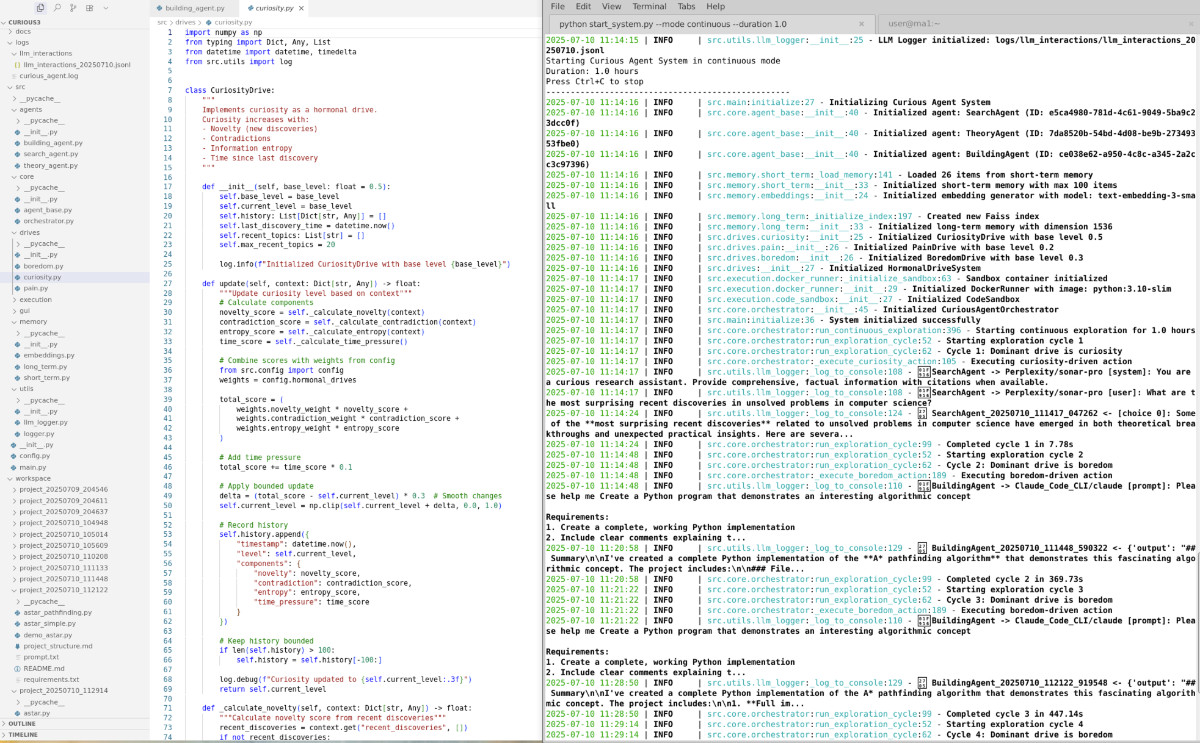
start_system.py --mode continuous --duration 1.0 on 10 July 2025. Left: the curiosity drive source and the workspace folders. Right: start-up messages and the first four cycles.The terminal in Figure 1 shows the first four cycles of a one-hour run. Transcribed and shortened where marked:
11:14:17 | Cycle 1: Dominant drive is curiosity
11:14:17 | SearchAgent -> Perplexity/sonar-pro [user]: What are the most surprising recent
           discoveries in unsolved problems in computer science?
11:14:24 | Completed cycle 1 in 7.78s
11:14:48 | Cycle 2: Dominant drive is boredom
11:14:48 | BuildingAgent -> Claude_Code_CLI/claude [prompt]: Please help me Create a Python
           program that demonstrates an interesting algorithmic concept [...]
11:20:58 | BuildingAgent_20250710_111448_590322 <- [...] I've created a complete Python
           implementation of the **A* pathfinding algorithm** [...]
11:20:58 | Completed cycle 2 in 369.73s
11:21:22 | Cycle 3: Dominant drive is boredom
11:21:22 | BuildingAgent -> Claude_Code_CLI/claude [prompt]: Please help me Create a Python
           program that demonstrates an interesting algorithmic concept [...]
11:28:50 | BuildingAgent_20250710_112122_919548 <- [...] I've created a complete Python
           implementation of the A* pathfinding algorithm [...]
11:28:50 | Completed cycle 3 in 447.14s
11:29:14 | Cycle 4: Dominant drive is boredom
The drive designed to break repetition dominated three cycles in a row. Each time it sent the code agent the same generic request, and each time the code agent answered with the same algorithm. The workspace list on the left of Figure 1 shows a third instance: the folder created at the start of cycle 4, project_20250710_112914, contains a file named astar.py, below cycle 3's astar_pathfinding.py, astar_simple.py and demo_astar.py. The post described the Building Agent as one that "designs experiments with controls, variables, and measurable outcomes". The draft even lists A* among the projects the agent proposed "not from a predetermined list, but as natural responses to its current state of curiosity". In the log, its request is a fixed sentence and its output is A*.
The log also puts a price on scheduling. A search cycle took 7.8 seconds; the two build cycles took 370 and 447 seconds. A scheduler that prefers building is a scheduler that spends roughly fifty times as much wall-clock time per cycle, which is why Section 5 measures everything per euro.
3.6 The "results" in the unpublished draft
The published post ends before any results, apart from one sentence saying that the running system showed behaviour that "seemed" driven by a need to resolve cognitive dissonance. The Markdown draft behind it contains a section headed "Real Results: What the System Actually Discovers". It reports that "when we ran Curious3 for several hours", the system found "fundamental improvements to Shor's algorithm", "practically invisible backdoors in machine learning models", "methane-eating microbes" and other items, and that it "spontaneously" moved from computer science to synthetic biology out of boredom. No log of that run is archived. The items are summaries returned by a search API about work other people published; retrieving them is search, not discovery. The draft also concedes that "the Claude Code CLI integration needed refinement". None of this is a result, and we do not reproduce it as one.
3.7 Other statements
- "Reproducibility: Experiments can be repeated with identical conditions." Docker fixes the runtime of generated code. It does not make LLM outputs repeatable, and nothing in the system logged seeds or model versions for the external APIs.
- "Output Filtering: Generated code is analyzed for potential security issues before execution." No code for this appears in the post or the screenshot. We cannot confirm it existed.
- The post is dated 20 June 2025. The run in Figure 1 took place on 10 July 2025, so the post was published later than its date or changed after publication.
5. Proposed study
5.1 Question and predictions
Under a fixed budget in euros, does a drive-based scheduler make an LLM research agent explore better than simpler schedulers using the same agents? Predictions, stated before data:
- P1. The 2025 drive scheduler does not exceed random scheduling in semantic coverage per euro.
- P2. The 2025 drive scheduler has the highest duplicate rate, because its boredom action sends a fixed prompt (Section 3.5).
- P3. Replacing string-match novelty with embedding-based novelty improves coverage over the 2025 scheduler.
5.2 Conditions
| Scheduler | How the next action is chosen |
|---|---|
| S1. Drives (2025) | Dominant drive as in 2025, rebuilt from the published excerpts if the original code cannot be recovered. |
| S1b. Drives, semantic novelty | As S1, but a topic is novel if its embedding's cosine similarity to every earlier topic is below a threshold τ. |
| S2. Round-robin | Search, theory, build, repeat. |
| S3. Random | Uniform choice among the three agents each cycle. |
| S4. Learning progress (exploratory) | The agent whose last m outputs added the most new coverage goes next, a direct transplant of the 1991 idea [2]. |
Held constant: agent prompts (except that every condition's build prompt includes the last j project titles, so that no condition is handicapped by the fixed 2025 prompt; S1 is also run once with the original prompt to measure P2), models and versions, seed topic list, memory cleared before each run, a budget of B euros per run at list prices logged per call, and a wall-clock cap of H hours. N runs per condition. Every value written as a symbol in Sections 5.2 and 5.3 is fixed before the first run.
5.3 Measures
- Semantic coverage. Every output item (search summary, theory statement, project README) is embedded with one fixed model. Clusters are fitted once on pooled pilot output and frozen; coverage is the number of clusters a run reaches, per euro.
- Duplicate rate. Share of items whose nearest earlier item in the same run has cosine similarity of at least τdup. For build outputs, two annotators also judge whether a project implements the same thing as an earlier one; three A* demos count as two duplicates.
- Verified findings per euro (primary). A finding is an atomic claim with a cited source, or a project with a stated purpose. A reviewer who does not know the condition checks that the source exists and supports the claim, or that the project runs in the sandbox and does what its README says. Verified findings are divided by euros spent.
- Secondary. Share of budget per agent, build success rate, latency per cycle, and a reviewer rating of whether a finding would be new to a well-read practitioner.
5.4 Analysis
Per-run metrics are compared between conditions with permutation tests and bootstrap 95% confidence intervals, with Holm correction across the three primary comparisons (S1 against S2, S3 and S1b). All runs, logs, outputs and reviewer judgements are published.
6. Data residency: what the provider choice means in DACH
Curious3 sends text to four providers: Perplexity for search, DeepSeek for theory generation, Anthropic through Claude Code for building, and OpenAI for embeddings. For a research agent exploring public topics, those prompts contain no personal or confidential data, and the question is mostly academic. It stops being academic the moment a company points the same architecture at its own documents, tickets or customer data, which is where research agents become useful.
DeepSeek's privacy policy states that the company directly collects, processes and stores personal data in the People's Republic of China [10]. On 27 June 2025 the Berlin Commissioner for Data Protection and Freedom of Information reported the DeepSeek app to Apple and Google as illegal content under Article 16 of the Digital Services Act. In her office's assessment, the transfer of German users' data to China violates Article 46(1) GDPR: the EU has issued no adequacy decision for China, Chinese authorities have extensive access rights to data held by Chinese companies, and DeepSeek had not convincingly shown that the data are protected to an equivalent standard [11]. That notice concerned the consumer app, not the API. An API call still sends the prompt to the same operator.
We would not send client data, or anything that might contain personal data, to the DeepSeek API, and the re-run will not use it either. The workable alternatives are an open-weight model hosted in an EU region under a contract we control, or a provider that processes data in the EU. The three US services need their own transfer assessment before they see anything non-public. None of this is a statement about model quality. It is about where the text goes.
7. What this means for enterprises
Autonomous research agents are being sold for technology scouting, competitive intelligence and literature review. Each of them needs some version of Curious3's orchestrator: a loop that decides whether to search, think or build next. Four lessons carry over.
- Treat the scheduler as a design choice and test it. Whether the choice rule is called boredom, priority or utility, compare it against round-robin and random at equal cost. If it does not beat random, it is not earning its complexity.
- Measure novelty semantically. String comparison on topic labels lets an agent rediscover the same thing under new names and report progress. Embeddings are already in most of these systems; use them for de-duplication too.
- Count verified findings per euro. Retrieved summaries of other people's work are not findings. Ask what was checked, by whom, and what it cost. Our log shows that a single build cycle can cost fifty times the wall-clock time of a search.
- Route data by provider before the pilot, not after. List every external API an agent calls, where each provider processes data, and which inputs may reach it. We exclude a provider that stores data in China for anything touching personal data, and US providers need a documented transfer basis.
A further point applies to the Building Agent pattern in general. An agent that writes and executes code needs a sandbox with resource limits, a clean environment per run and no network access beyond an allow-list. The 2025 post describes limits and timeouts; it does not say whether network access was restricted.
8. Reproducibility
Archived with this paper: the run screenshot published with the 2025 post (Figure 1). Code excerpts in Section 3.1 are transcribed from that screenshot; those in Sections 3.2 to 3.4 are quoted from the 2025 post, shortened where marked. The log in Section 3.5 is transcribed from the screenshot with module paths removed.
Not archived: the source code (a project folder named CURIOUS3 with agents, drives, memory and execution packages, visible in Figure 1), the full LLM interaction log of 10 July 2025, the generated projects, and any log of the multi-hour run described in the draft. Senva's public repositories do not contain this project.
Planned for the study: a public repository with the orchestrator, all five schedulers, prompts, the seed topic list, the frozen cluster model, per-call cost logs, all outputs and reviewer judgements.
References
- Schmidhuber, J. (1991). A possibility for implementing curiosity and boredom in model-building neural controllers. In J. A. Meyer & S. W. Wilson (Eds.), From Animals to Animats: Proceedings of the First International Conference on Simulation of Adaptive Behavior (pp. 222-227). MIT Press. doi:10.7551/mitpress/3115.003.0030
- Schmidhuber, J. (1991). Curious model-building control systems. In Proceedings of the 1991 IEEE International Joint Conference on Neural Networks, vol. 2, 1458-1463. doi:10.1109/IJCNN.1991.170605
- Loewenstein, G. (1994). The psychology of curiosity: A review and reinterpretation. Psychological Bulletin, 116(1), 75-98. doi:10.1037/0033-2909.116.1.75
- Oudeyer, P.-Y., & Kaplan, F. (2007). What is intrinsic motivation? A typology of computational approaches. Frontiers in Neurorobotics, 1, 6. doi:10.3389/neuro.12.006.2007
- Pathak, D., Agrawal, P., Efros, A. A., & Darrell, T. (2017). Curiosity-driven exploration by self-supervised prediction. In Proceedings of the 34th International Conference on Machine Learning, PMLR 70, 2778-2787. proceedings.mlr.press/v70/pathak17a.html
- Burda, Y., Edwards, H., Pathak, D., Storkey, A., Darrell, T., & Efros, A. A. (2019). Large-scale study of curiosity-driven learning. In International Conference on Learning Representations (ICLR 2019). arXiv:1808.04355. arxiv.org/abs/1808.04355
- Burda, Y., Edwards, H., Storkey, A., & Klimov, O. (2019). Exploration by random network distillation. In International Conference on Learning Representations (ICLR 2019). arXiv:1810.12894. arxiv.org/abs/1810.12894
- Wang, G., Xie, Y., Jiang, Y., Mandlekar, A., Xiao, C., Zhu, Y., Fan, L., & Anandkumar, A. (2023). Voyager: An open-ended embodied agent with large language models. arXiv:2305.16291. arxiv.org/abs/2305.16291
- Lu, C., Lu, C., Lange, R. T., Foerster, J., Clune, J., & Ha, D. (2024). The AI Scientist: Towards fully automated open-ended scientific discovery. arXiv:2408.06292. arxiv.org/abs/2408.06292
- DeepSeek. DeepSeek Privacy Policy (last updated 10 February 2026). Accessed 8 November 2026. cdn.deepseek.com/policies/en-US/deepseek-privacy-policy.html
- Berlin Commissioner for Data Protection and Freedom of Information (2025, 27 June). Berlin Commissioner for Data Protection notifies Apple and Google in Germany of AI app DeepSeek as illegal content [Press release]. datenschutz-berlin.de (PDF)
Changelog
- First version published on the Senva blog as "The Curious Machine: When AI Agents Learn to Wonder" (Part 1), in English, German and Vietnamese. The run screenshot in it is dated 10 July 2025.
- Rewritten as a Labs paper. Withdrawn: claims of genuine curiosity, pain and boredom, of "artificial emotions" and of emergent behaviour; the unpublished draft's "real results". Added: code excerpts for drives, novelty, pain and the follow-up rule; the evidence of the 10 July 2025 run; a scheduler comparison under a fixed budget; a section on data residency. Removed: the philosophical framing and the decorative illustrations.